
The Under Reported War - Issue 31
EU releases 90bn Euros / Path for EU membership clear / Storm-Z and graveyards / Drone Wall expands / Punching holes and drilling corridors in Russian air defences / Tuapse refinery burns unchecked

Welcome back to the weekly roundup of news from the war in Ukraine you probably did not hear about.
All reports are linked to their sources so you can read the original if you’d like to. If you have any questions, detect errors and omissions, or need more detail, just let me know.
Here are some of the things you probably did not hear about for the week covering Sunday 19th to Saturday 25th April 2026.
By the way, today is Day 1,524 of Putin’s 3-Day Special Military Operation.
Which reminds me. Take a look at these two maps of the frontline. One is from last week, the other is from exactly a year earlier. Can you spot any differences between them? There are some changes, but they are minuscule: some fields, a few hamlets, and the occasional town. That’s it. In a whole year of fighting and taking record losses, Russia’s advance has been pitiful.
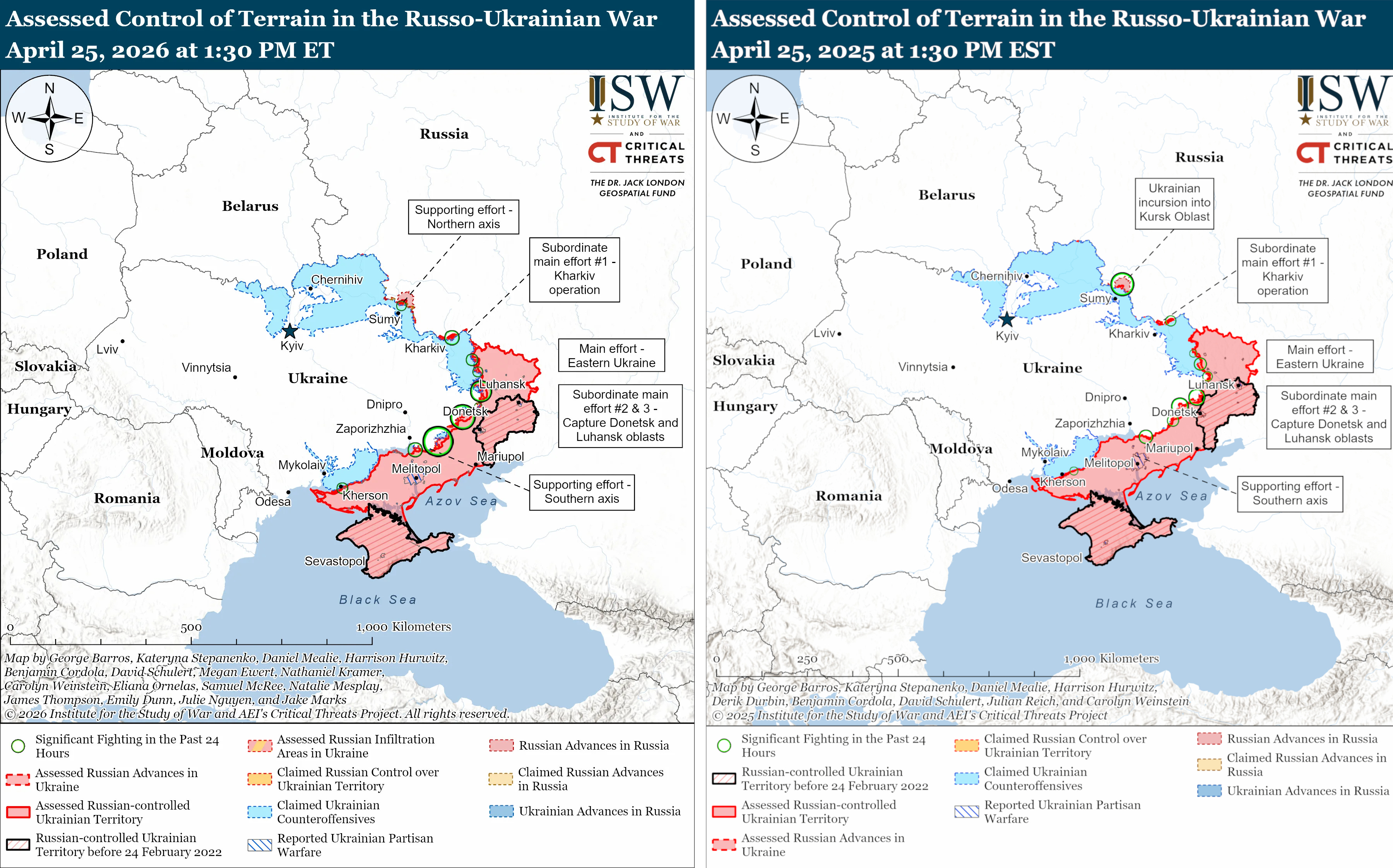
Two maps. April 25th 2026 is on the left. April 25th 2025 is on the right. Spot the differences. They are there, but you might need a magnifying glass to find them. Source: ISW
I am not quite up to speed again, but here goes. This week, I’m going to do a roundup of just a few of the topics that I regularly cover but which have become more pressing since I last posted in September. But first, the here’s the big news of the week that you may not have heard.
TWO HEADLINES THAT NEVER WERE (BUT SHOULD HAVE BEEN)
RUSSIAN FROZEN ASSETS FUND UKRAINE’S WAR AGAINST, ER, RUSSIA
——————————————
€90 billion for Ukraine—two-thirds of the 2026–27 budget gap—clears Brussels Wednesday
link
“The money covers two-thirds of what Kyiv needs to keep the state running and the army supplied through 2027, and it unlocks an additional $8.2 billion IMF program that has been waiting on the EU disbursement. The loan had been blocked for two months by Viktor Orbán, who lost Hungary’s 12 April election after 16 years in office.”
This sum alone is almost double the entire amount of military aid provided by America to Ukraine over the entire course of the war. It is drawn from the interest accrued on Russian assets frozen by the EU and the UK. That pot of gold is re-filling fast . That new interest will provide similar sums for Ukraine in the future.
Yes, the interest earned from Russian assets is paying for Ukraine’s defence. Makes me smile every time I think about it.
——————————————
EU CLEARS ROUTE FOR UKRAINE’S MEMBERSHIP (AND MOLDOVA TOO)
——————————————
EU forges ahead with membership for Ukraine and Moldova after Orbán’s exit
link
“Key negotiating “clusters” will be unblocked, opening the path to the two nations joining as members of the bloc.”
This was one of Putin’s red lines back in 2022. No one pays attention to him anymore. Moldova, long regarded (by Putin) as inside Russia’s sphere of influence is also being fast-tracked into membership. Congratulations to both nations and hopefully accession will not take too long.
——————————————
I cannot explain why these two stories got so little attention elsewhere. Sigh… welcome to The Under-Reported War.
THE CONTINUING DECLINE OF RUSSIA’S “INVINCIBLE WAR MACHINE”
——————————————
DEATH MARCHES, STORM-Z, & GRAVEYARDS
——————————————
A handful of open source intelligence researches monitor Russian social media, then translate what they find and publish it online. A lot of their work will feature in this bulletin since it gives otherwise unheard insights into what is happening to Russia’s army and populace. Thanks in particular go the ChrisO_wiki and WarTranslated.
——————————————
New graveyards are no longer confined to the lands of ethnic minorities in the remote Far East. This video was taken in a new cemetery outside St.Petersburg, Russia’s second city and former imperial capital.
“Guys, there was an empty field here in the fall”
link
“ These are our fathers, husbands, and sons…. I suppose this is exactly what Putin intended, everything is going according to plan.”
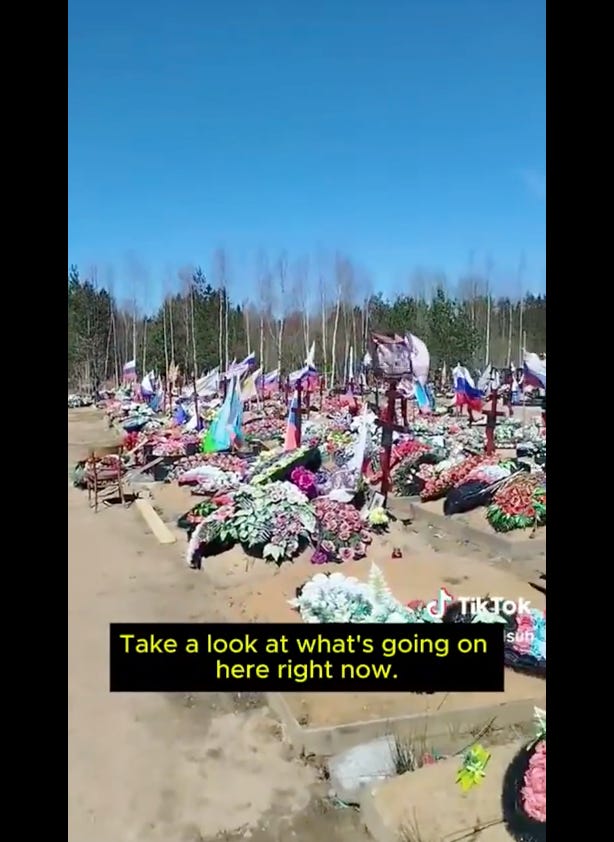
Fresh dug graves in the heart of old Russia / Video screengrab
Storm-Z are the infantry formations forced to attack across Ukraine’s 20km deep Drone Wall. No matter your speciality, irregardless of how highly-trained you are, no one seems safe from the threat of the meat grinder. In the last year, I have heard of sailors, aviation pilots, aircraft maintenance crews, artillerymen, signallers, drone pilots, and tank crews all sent to die in Storm-Z units.
Ukraine claim’s a 80% or higher kill rate on these hapless foot-sloggers with 95% of drones hitting targets. Yes, that means eight out of ten Russian casualties are now deaths. I am certain there has never been a modern war where the death rate was so high. Before the invasion in 2022, if an army formation took 10% casualties (both wounded and dead) it was considered to be no longer functional. Not so in Putin’s army. Oh, and Ukraine’s data is accurate. A drone strike has to be verified by video footage for it to be included.
Here’s some good examples of the Storm-Z madness that goes on in Russia’s army. Almost all of these were posted online in the last week. And every week there is yet more of the same.
——————————————
The developers of the Russian heavy bomber drone ‘Kukushka’ have been sent to their deaths en masse
link
“Almost all of the men were killed, including the lead developer, Junior Lieutenant Alexey Olegovich Glazkov… This was despite another unit seeking to transfer Glazkov to its ranks to that he could develop his drones further there.”
Baba Yaga heavy bomber drones terrorize the Russian frontline. Some Russian soldiers decided to build their own and it was successful. However, their unit commander had to dispatch a tithe to Storm-Z so off they were sent to die. In Ukraine’s army, these guys would have been praised, promoted, and their design put to good use.
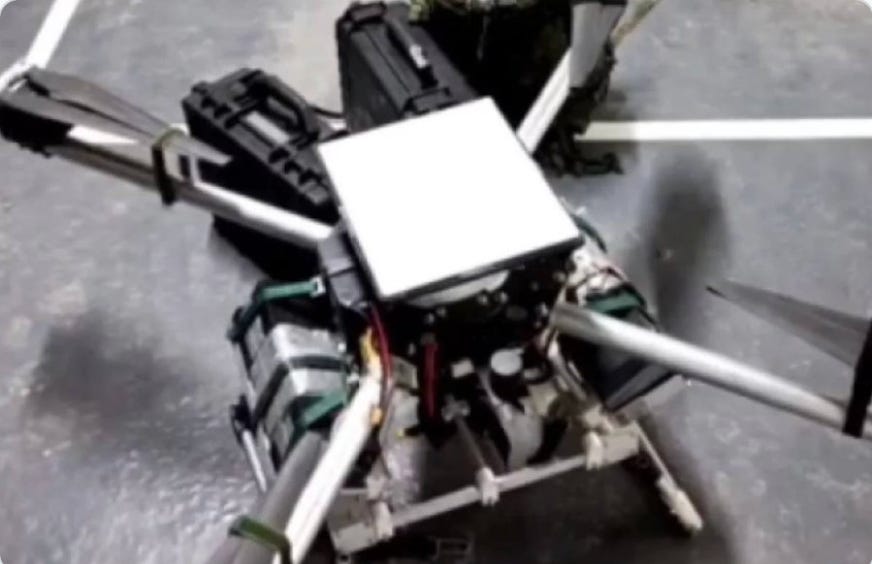
The ‘Kukushka’ heavy bomber drone, designed and built Ukrainian-style by soldiers on Russia’s frontline. Those same solders were then sent to die in a Storm-Z assault by their CO / Screengrab
——————————————
The military police have Storm-Z quotas too:
Russian soldiers are being sent to their deaths by the military police for infractions as trivial as not wearing a seatbelt
link
“The Military Police (VPs) are the target of widespread hatred from ordinary Russian soldiers for their corruption and zealous enforcement of arbitrary rules. They are also helping to meet the army replenish depleted assault units by sending arrested individuals to them. “
——————————————
As mentioned already, trained tank crews being fed into the meat grinder too.
Russian tank crews are being sent to their deaths en masse in infantry assaults
link
“With tank use now severely limited due to drone strikes, their crews appear to be surplus to requirements… “Companies no longer have three platoons; they exist only on paper, but in reality, all the soldiers were sent to the assault, were killed, or went missing.””
——————————————
Many of you will recall the reports on Russia’s ‘Crutch Battalions’ where badly wounded and crippled soldiers were forced into assaults with predictable consequences. Well, now it has got worse. Much worse. There is no escape from Storm-Z even if you are mobilised or foolish enough to sign a contract.
Recently posted videos suggest that reservists are being transported in handcuffs
link
“Men who have lost legs and arms are also being sent into assaults… The Russian army is recruiting incontinent, brain-damaged men who are incapable of fighting and are literally having to be carried around.”
——————————————
This next video has to be seen to be believed.
Russia is proclaiming success in its ongoing recruitment drive, but this is being achieved by scraping the bottom of the barrel
link
“A newly-published video shows the abysmal quality of the current recruits: old, disabled, and homeless men, with only two fingers between them.”

Count them. Three recruits. Two fingers between them. They were passed fit for combat / Video screengrab.
Russia is using ‘disposable’ men
link
“The Russian army is recruiting alcoholics directly from rehab and sending them to the front line, according to a serving Russian soldier, who says they “couldn’t even walk, and they’re also just plain sick in the head.”“
——————————————
Another mass mobilisation is creeping ever nearer.
A Russian region has ordered businesses to send their employees to fight
link
“Varying recruitment quotas have been set depending on the size of the business. The ‘voluntary-compulsory’ scheme appears to be a de facto form of mobilisation… ”
——————————————
STARLINK, TELEGRAM, AND BATLEFIELD COMMUNICATIONS
——————————————
Back in February, pirated Starlink terminals used by the Russian military were bricked. The most important consequence is that Shahed-style kamikaze drones can no longer navigate accurately using Starlink. However, it also crippled the Russian army’s ability to co-ordinate quickly with other units, call in artillery support etc.
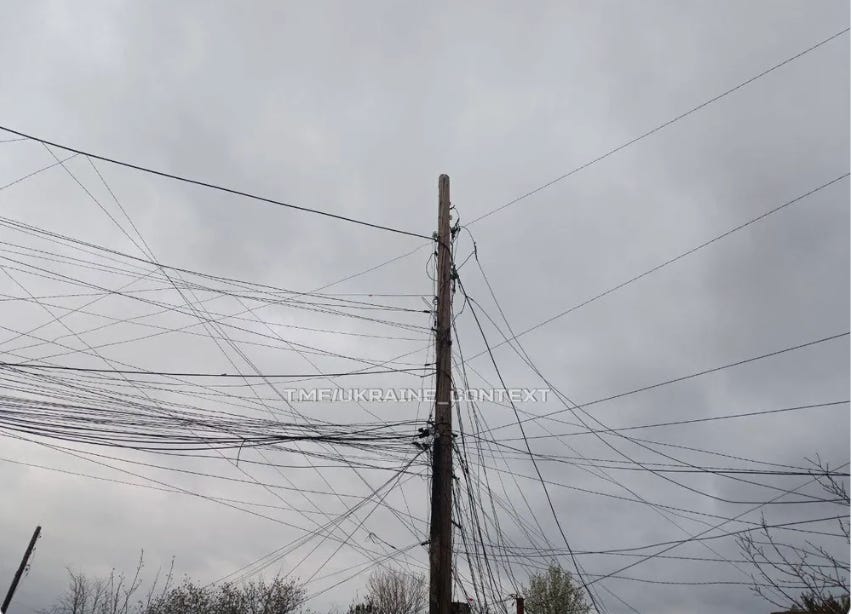
The 20th Century would like to welcome back the Russian Army / Screengrab
Russian army laying internet cables to each position
link
“Due to Starlink being blocked, the Russians have been set back a century and are now manually laying internet cables to each position.”
——————————————
In an act of complete idiocy, the Russian government then banned the use of the highly popular encrypted social media site, Telegram. Guess who, in particular, had put it to good use because their own official communication systems were so useless? The Russian army, of course. Chaos then ensued.
Telegram Banned
link
“Leaked orders from the Russian Ministry of Defence show that Telegram is being banned immediately for operational use by Russian forces in Ukraine, with soldiers reportedly facing being sent to their deaths in assaults if they are found not to be complying.”
The ban had many unforeseen consequences. Russian frontline units suffer from equipment shortages, corruption, and poor quality gear when some, if any, ever arrives. They depend upon donations from the civilian population to make up the shortfall. Without Telegram, co-ordinating this effort has become impossible.
Civilian donations to the Russian army are said to have have collapsed
link
“The impact on the front line is likely to be severe… the Russian army is dependent on volunteer donations for a huge amount of equipment, ranging from medicines, to generators, to vehicles.“
And the effects of the ban reach far further into civilan life and businesses.
The blocking of Telegram by the Russian government is a disaster for huge numbers of Russian businesses and citizens
link
“Telegram, which was developed by Russian entrepreneur Pavel Durov, is almost universally used by Russians. It has become an essential business tool, with virtually every company in Russia advertising on it and many running their own channels for customers.”
So why was act of military and economic sabotage carried out? This being Russia, there are many suggestions. Here are a couple of likely contenders. Of, course, one being true does not rule out the other also being true.
Morass of corruption and brutality at the top of the Russian army
link
“A huge cache of messages [hacked by Ukraine] from the phone of Russian Major General Roman Demurchiev provides a unique insight into the inner workings of the Russian army. It reveals a force riven by feuds between generals, plagued by corruption, and full of contempt for superiors and peers.”
Limit People’s Power to Spread Dissent
link
“The Russian government is blocking Telegram to destroy the Russian people’s social connections, says former high-level government advisor German Klimenko. The frank admission has caused outrage among Russian commentators.”
Oh, I almost forgot to mention that Ukraine took advantage this comms disaster to disrupt completely Russia’s spring offensive with local counter-attacks plus launching drone attacks that savaged Russian logistics.
THE DRONE WALL EXPANDS
KILLER DRONES SWARM
——————————————
Ukraine made a smart decision about its manpower shortages and losses. It stripped most of infantry from the frontline. No soldiers means no-one to kill. Instead, it has maximised its advantage in drone numbers, in technology and in innovation to create the Drone Wall. It started out as a 15km deep kill zone along the entire 1300km frontline, patrolled by reconnaissance drones, small FPV drones, and larger Baba Yaga bombers. This year, the Wall has expanded to a depth of 20km.
Any attacking Russian vehicles or foot soldiers have to run this drone gauntlet before they even get close to any Ukrainian troops. They rarely make it. Backed by artillery, mines, and static obstacles the Drone Wall has become a killing ground. This is why Russia takes more than a thousand confirmed casualties everyday. And, remember, at least 80% of those are killed. Night is no advantage for the invaders. Drones have infra-red cameras and night vision too.
The Drone Wall not perfect, but for the last few month, Ukraine has restricted Russian advances to the point that their big spring/summer offensive stalled before it ever got going.
Ukraine Gains Upper Hand
link
“Ukraine’s increasing dominance in drones is reportedly leading to individual Russian soldiers being attacked by 20 or 30 drones. Russian warbloggers say that Ukrainian drones are operating with impunity while their side faces a shortage…” “It’s a well-known fact—and an unpleasant one—that over the past few months, the enemy has rapidly gained the upper hand in terms of drone numbers, both on the front lines and in our rear areas.””
——————————————
One of the reasons for the Drone Wall’s success is the ubiquity of its surveillance drones. They observe enemy movement and vector FPV drones, loitering munitions, or artillery in for the kill. The frontline has become a panopticon. These Ukrainian drones have achieved aerial superiority over the battlefield.
I won’t show you the myriad of videos of Russian soldiers being hunted by FPVs. Instead, here’s an unusual example of how the Drone Wall works. A surveillance drone guides an FPV drone in to attack a Russian crew retrieving one of their own expensive Orlan surveillance drones. Most of the crew escape but their vehicle is destroyed. And you can be sure FPV drones were then sent to wreck the Orlan too.
Surveillance drone targets Russian surveillance drone retrieval crew
link
“Ukrainian artillery reconnaissance brigade Chornyi Lis struck a Russian Orlan drone crew attempting to retrieve their UAV in a field.”
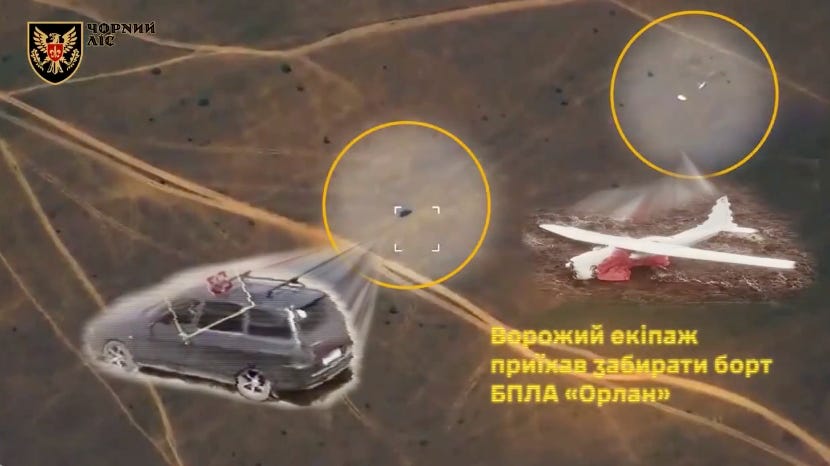
Guided by a reconnaissance drone, the car was struck whilst driving towards the Orlan drone / Video screengrab
——————————————
UKRAINE TRIPLES FIBRE-OPTIC DRONE PRODUCTION
——————————————
Fibre-optic drones are not perfect weapons. They have their problems but, as ever, Ukraine is busy trying to solve them. It has been claimed recently that their range has been extended to 50km. They are the perfect ambush drone, able to lie in wait passively until a target appears. Last year, Russia fielded more of them. This year, that lead has switched to Ukraine.
Ukraine delivered 92% of last year’s fiber-optic drone total to front[line] in under four months
link
“Ukraine’s just solved the fiber-optic cable price problem.”
THE DEMOLITION OF RUSSIAN AIR DEFENCES
Russia anti-aircraft missile brigades have taken shocking losses. Many of you know that already, of course. This year Ukraine increased the intensity of its attacks even further.
——————————————
RUSSIA’S TIERED AIR DEFENCE
——————————————
Ground-based air defence is tiered. There are short range radar-guided gun and missile batteries. Then medium range missile launchers like the Buk M1-M3. Finally, there are very expensive long-range missile batteries. All of these are directed onto targets by a complex mix of even more expensive radars. Ideally, all of the missile launchers and radars are positioned to overlap each other, defending each other’s weaknesses whilst making it suicidal for enemy aircraft to try to penetrate. Drones have changed all that. Russia has chosen to mass a lot of its ground-based air defences behind the frontline, mostly (but not all) out of range of FPV drones. Ukraine has worked out how to destroy them systematically.
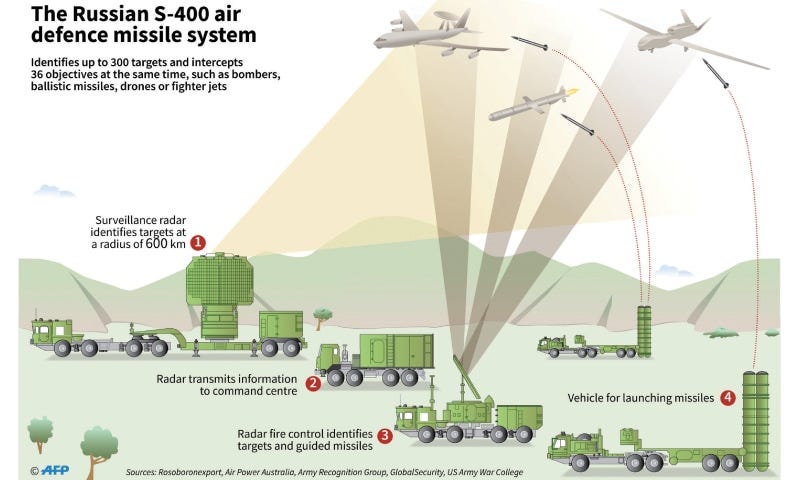
Russia’s S-400 missile battery showing launchers and radars. Source/AFP
The S-400 is one of Russia’s most deadly surface-to-air missile (SAM) systems. Its predecessor, the S-300, is more common and looks similar. There are even more sophisticated systems too: the S-350 and S-500, but they are rarely deployed close to the frontline, although Crimea has proved to be a happy hunting ground for Ukrainian drones.
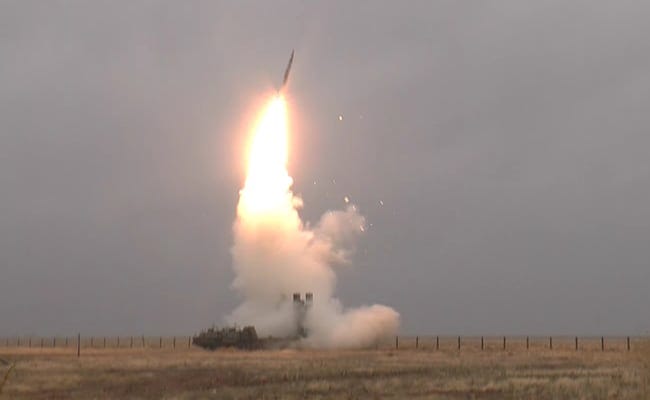
S-400 missile launches / Open source
These long-range launchers are defended by shorter range but more agile Tor and Pantsir SAM systems and others.
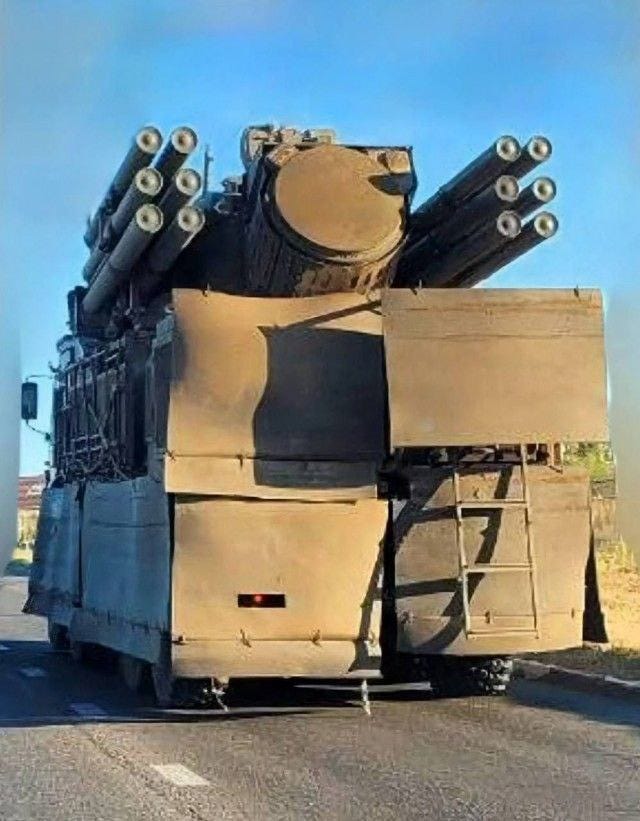
The Pantsir S1—Russia’s not-so-effective drone killer—seen here with DIY rubber screen drone protection. All those guns, all those missiles, and all that rubber did not keep it safe from cheap drones. It was destroyed by a drone, of course, soon after this photo was taken. It’s great to have a chance to run this truly bonkers photo again. Source: The Vodogray magazine
It makes no difference, Ukraine is tearing these defences apart.
Blinding the Bear and Pulling Its Fangs
link
“Since the full-scale Russian invasion of Ukraine in February 2022, the conflict has become the most intensive laboratory for modern long-range warfare since the Second World War.
Amid the grinding attritional struggle along the front lines, a quieter but strategically consequential campaign has unfolded deep inside Russian territory: a systematic Ukrainian effort to degrade, disrupt, and destroy the integrated air defence network that Moscow depends upon to protect its strategic assets, power projection capabilities, and territorial depth.
Targeting the radars that give Russia its eyes over the battlefield and the surface-to-air missile systems that constitute its fangs, Ukraine has waged a campaign that challenges fundamental assumptions about the durability of layered air defence in high-intensity conflict.”
Ukraine is mass-producing medium-range drones. These are cheap, can fly very low, and, if six are shot down in an attack but the seventh hits its target then a multi-million dollar high-tech SAM. system and its expensively trained crew goes up in a ball of flames at relatively little cost to the attacker and at no cost in Ukrainian lives.
——————————————
PUNCHING HOLES AND DRILLING CORRIDORS
——————————————
Most days and nights, Ukraine’s surveillance and kamikaze drones punch into Russia’s air defence and attempt to open safe corridors for large numbers of longer range drones to swarm through and attack Russian military infrastructure and industries. They are frequently successful.
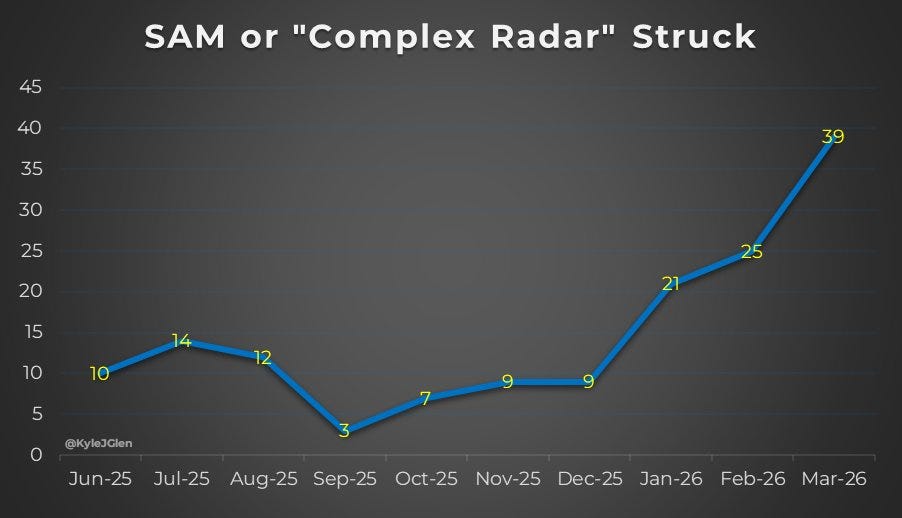
Ukraine prefers to destroy the high-tech radars because they are so complex and expensive to repair. Without target identification and tracking radars the missiles are blind / @KyleJGlen (Twitter/X)
Russian Air Defence Losses Soar to Record High in March 2026
link
Ukraine’s drone units have struck 85 SAM [surface-to-air missile] systems or “complex radars” in 2026... This is a 240% increase on the previous 3 months and is almost certainly why we’re seeing more success from Ukraine’s long-range strikes.”
——————————————
The anacronym for this kind of campaign is DEAD (Destruction of Enemy Air Defences). Here’s an example from one night last week.
Drones destroyed 4 Russian air defense systems in one night
link
“It just keeps going. Ukraine’s DEAD campaign: Drones have destroyed 4 Russian air defense systems in one night, including multiple Tor-M2 units and an Osa system across occupied territories and Bryansk region. Additional strikes targeted fuel tanks and logistics hubs supporting Russians.”
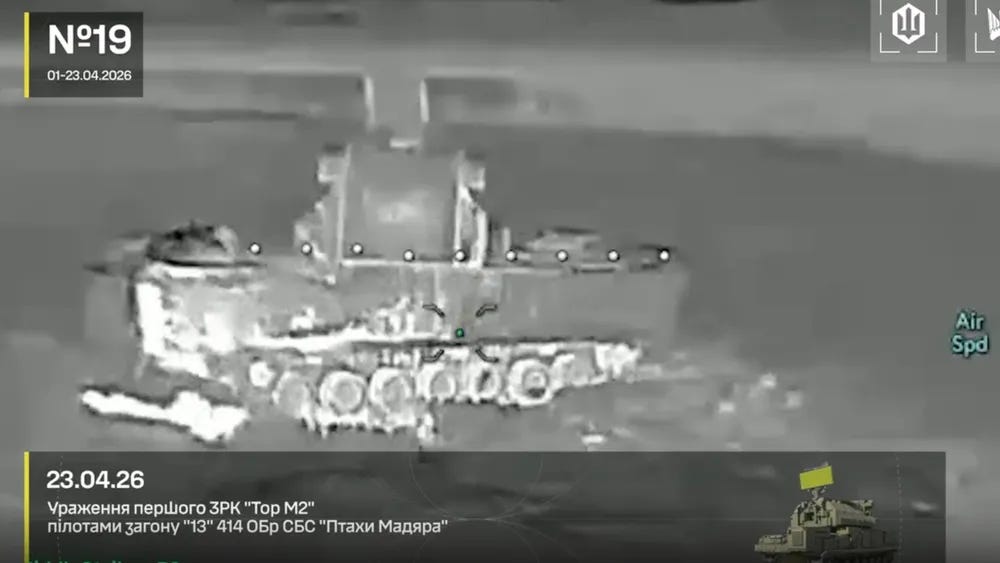
The target is a ’drone-killing’ TOR missile launcher. The picture was taken by a drone on final attack. Note the interference-free video image. It’s a sign of how thin-spread and ineffective Russia’s electronic jamming has become. Russia was once the undisputed world leader in this field / Video screengrab
The problem is now matter how many missiles you pack, when you run out there is nowhere to hide. Your multi-million dollar high-tech weapon becomes a sitting duck.
——————————————
PANTSIRS ARE PANTS?
——————————————
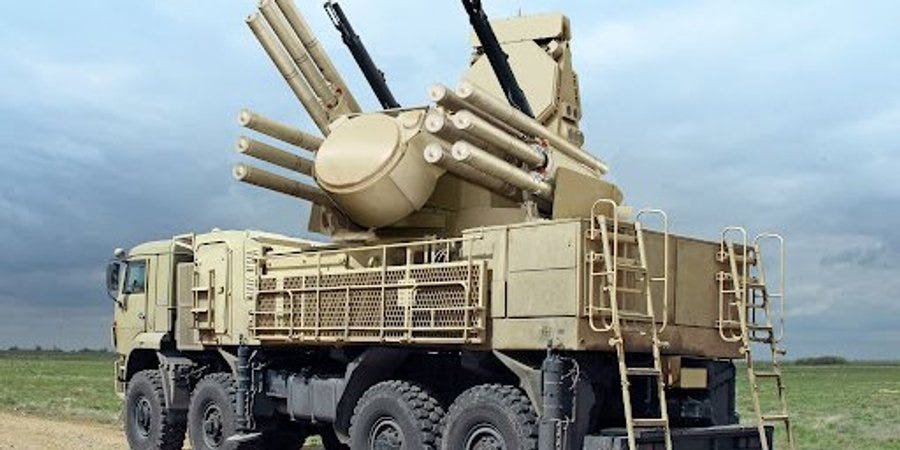
Russia markets the Pantsir short-range air defence system as a ‘drone-killer’ to the rest of the world. To overcome it’s, ahem, vulnerability to FPV drones in particular, Pantsirs are now being lifted by cranes to the top of 30m high towers, tall buildings (sometimes residential) in Moscow, or any available steep hillock. With elevation, the Pantsir has a better chance of targeting a ground-hugging drone.
100 New Flakturm-Like Towers for Pantsir Systems Built in 2025
link
“By the end of 2025, Russia had constructed about 100 additional positions for Pantsir air defense systems across the European part of the country. These positions are often informally referred to as “towers” and can be compared to the Flakturm anti-aircraft towers built by Nazi Germany during World War II.”
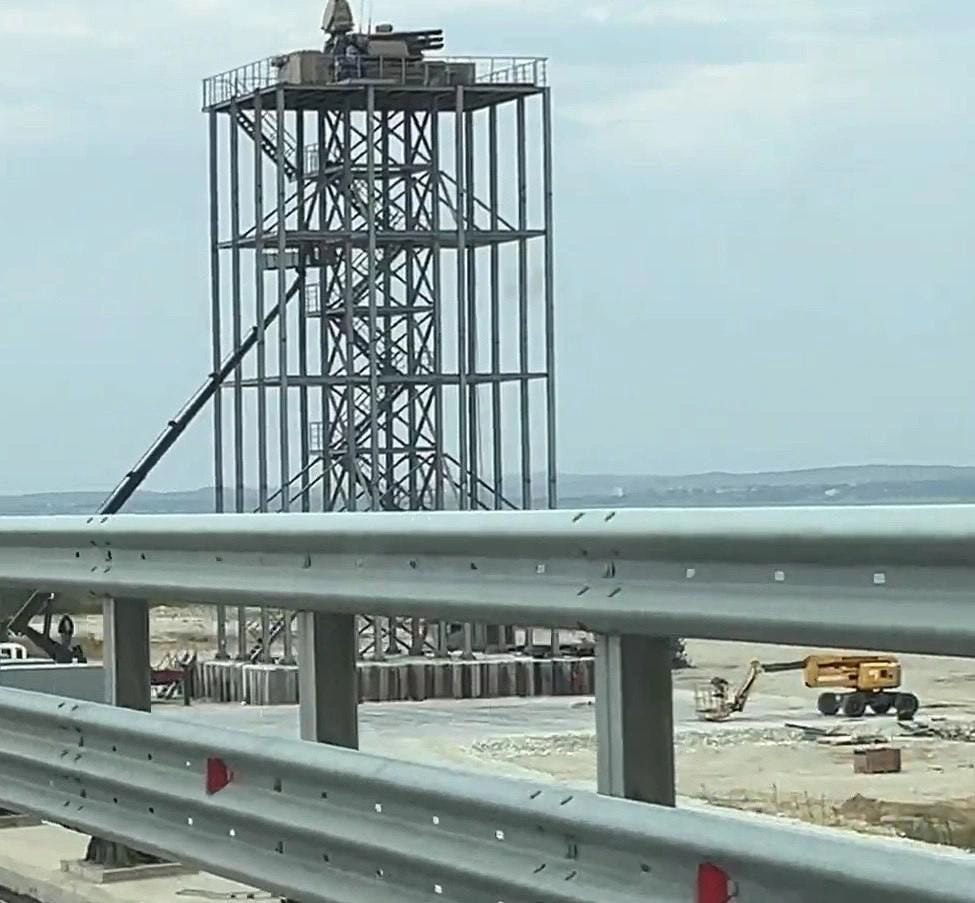
Newly installed Pantsir atop it’s tower / Open source
All that sounds great, but an official report from 2020 revealed Russia has long known the Pantsir is next to useless against small aircraft let alone drones.
Russia’s Pantsir air defense system vulnerable to drone strikes
link“The Russian military touts the system as top tier, but evidence from the battlefield and studies prove it cannot defeat long-range drones or small aircraft.”
——————————————
To absolutely no one’s surprise, Putin and his siloviki inner circle look after themselves first.
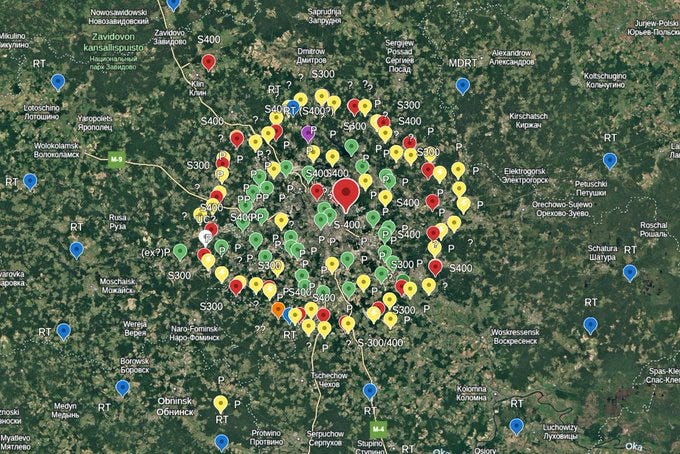
This map marks the sites of elevated Pantsirs (yellow) around Moscow./ Source: @Jembob (Twitter/X)
The massive expansion of [short range air defence] positions in Russia last year
link
“Between May and September [2025], approximately 43 new Pantsir towers were built for the new 50km ring around Moscow”
——————————————
If anyone should doubt Putin’s priorities, another 19 Pantsir towers encircle Putin’s dacha’ (AKA lakeside palace with its own underground railway station) at Valdai, WNW of Moscow.
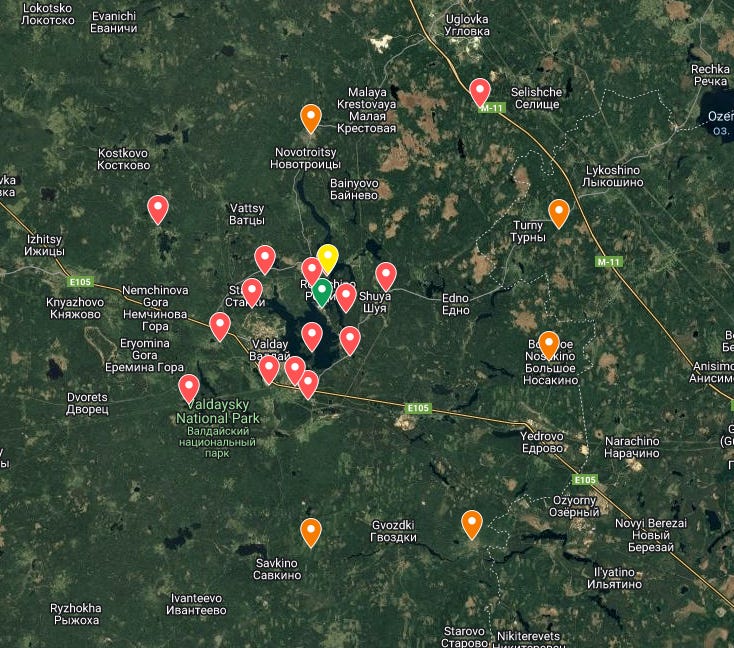
Red and orange mark the Pantsir sites. Yellow marks the long-range SAMs. Green marks the dacha / Source: Mark Krutov (@kromark Twitter/X)
Nineteen Pantsir towers within 20km radius of Putin dacha
link
“Total of 19 (!) towers now to guard Putin and his mistress, Alina Kabaeva + S-300 position + EW”
There is also the largest wartime concentration I have seen of what appear to be S-400 and possibly S-500 SAM launchers (yellow tag on the map). Here’s Mark Krutov’s annotated map so that you can look for yourself:
It’s also fun to just do a search for ‘Valdai, Russia’ on Google Maps then try to pick out the Pantsir towers for yourself. Clue: the towers cast very long shadows.
——————————————
Putin and his coterie clearly place a lot of faith in the Pantsir. However, recent history (launching a failed invasion, triggering NATO expansion, Ukraine now fast-tracked for EU membership etc, etc) shows their judgement is not quite as good as they assume. Let’s see how its working out for them this time:
Hilltop Pantsir Fails to Defend Crimea Oil Depot
link
“The position of a Russian Pantsir-S1 air defense system and the wrecked oil depot in Feodosia, Crimea, that it was supposed to protect.”
Here’s a satellite image of the smoking wreckage from the aftermath of recent waves of drone attacks. The refinery burned for days. The Pantsir sits inside the red box.
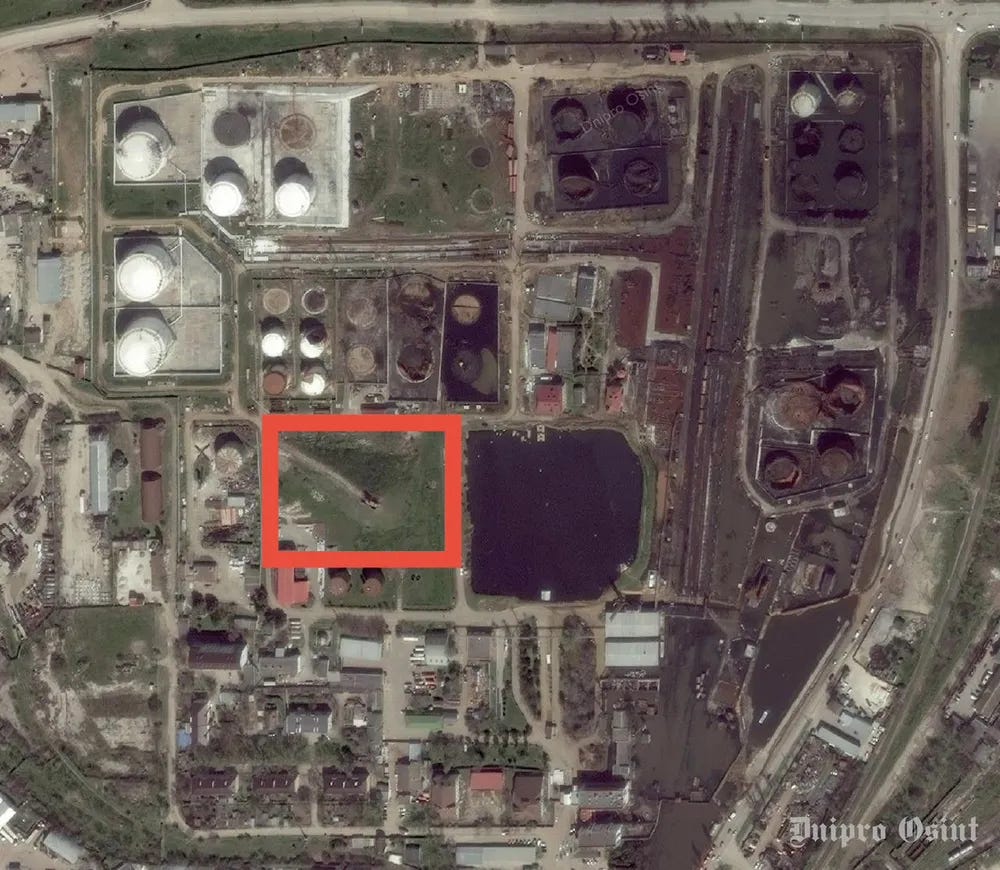
Ukraine is methodically destroying the Feodosia depot despite its air defences / Source: Dnipro Osint
——————————————
THE FP-2 NOW ATTACKS IN PACKS
——————————————
Last year, Ukraine used Firepoint’s Lyuti FP-2 drone for often symbolic long-range attacks on high value targets deep inside Russia. Often only one or two FP-2s would get through and, to maximise range, they flew with small explosive payloads.
This year, the FP-2 hunts in packs. Their range has been shortened to allow heavier 100kg warheads. They are now deadly. The video below gives an excellent demonstration of how Russia’s defences are being worn down.
Ukraine Destroys Ninth Tor-M1 System in Nine Days After Drone Wave Exhausts Missiles
(Video worth watching)
link
“A fight between a Russian Tor M1 [anti-air missile system] and Ukrainian FP-2 [drones] unfolded over occupied territory… The first drone spotted missile launches and was shot down, the second FP-2 was also intercepted… Using live feed from the first two, a third FP-2 located the Tor and returned for a second pass, striking the target.”
The second half of this video shows how, once air defences are destroyed, another wave of FP-2s devastates a supply depot.
——————————————
This next video is also worth watching for the sheer number of carefully placed FP-2 strikes that demolished a HQ of the 58th Combined Arms Army last week. This kind of methodical assault did not happen last year, most of the drones would have been shot down.
Ukraine’s FP-2 Drones Are Building-Busters
(Video worth watching)
link
“One critical target went up in smoke on or before Friday, when [six] Fire Point FP-2 drones blew up a headquarters reportedly belonging to the Russian 58th Combined Arms Army in Kadiivka, 30 miles west of the no-man’s-land in eastern Ukraine’s Donetsk Oblast.”
——————————————
This final FP-2 video, also from last week, is of an attack of eight FP-2s on a FSB (successor to the KGB) secret police command post in occupied Ukraine. The drone pilot skills and degree is accuracy are phenomenal. Again, an attack like this could only occur because Russia’s air defences are so degraded.
Secret Police HQ Eliminated
(Video worth watching)
link
“Ukrainian FP-2 drones have struck an FSB command post in occupied Donetsk, destroying the facility in 8 precision strikes. Ukrainian intelligence reports 12 officers killed and 15 wounded among FSB personnel”
It was arguably more precise than even the famous Mosquito raid on a Gestapo HQ in 1945. Cue gratuitous photograph:
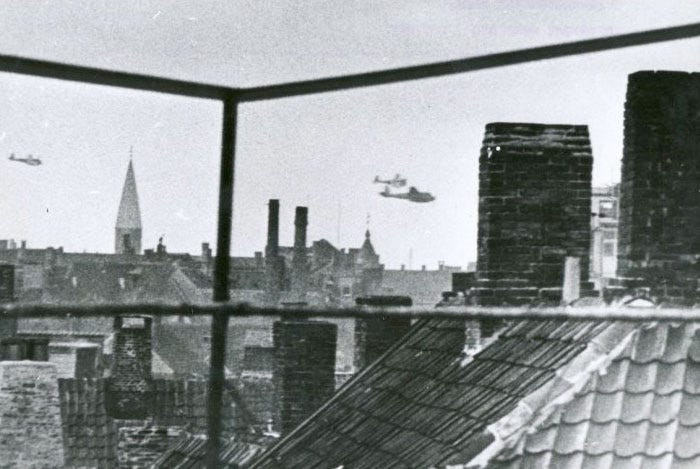
RAF Mosquito bombers fly at rooftop height in their successful pinpoint destruction of the Gestapo HQ in Copenhagen, Denmark, 21st March 1945.
——————————————
UKRAINE’S AIR FORCE IS ON THE OFFENSIVE TOO
——————————————
Amazingly, Ukraine’s fighter-bombers appear to be launching bombs inside Russian-controlled airspace. It is several years since this last happened and was abandoned back then because the losses were too costly. Until now, Ukrainian jets have been releasing glide bombs from safety behind the frontlines.
Two weeks ago, using air-launched Storm Shadow cruise missiles Ukraine attacked a Shahed storage site. This was an ultra-high priority target more than 40km behind the lines in occupied Donetsk. The attack was combined with glide bombs released by Mig-29 fighter bombers. Dropped at low-level, 40km is at the extreme end of the GBU-39 glide bomb’s range. At high altitude, the GBU-39 flies over a 100km. In the past, at any height, the tiered Russian air defence would expect to shoot down Ukraine’s Mig-29s with ease if they flew this close. Ukraine was clearly confident this would not happen. They would not risk their few precious aircraft otherwise.
Russian air defenses are collapsing. Now Ukrainian warplanes can hit harder
link
“It’s no surprise the Ukrainian air force targeted a Russian [Shahed] drone storage site in Donetsk recently. It’s how the air force hit the site that’s surprising. And bad news for Russia. A 14 April raid on a Russian drone storage site in Donetsk city was only possible because previous raids cleared a path through Russian air defenses. The attacks on Russia’s drone storage is helping slow the pace of Russian raids on Ukrainian cities”
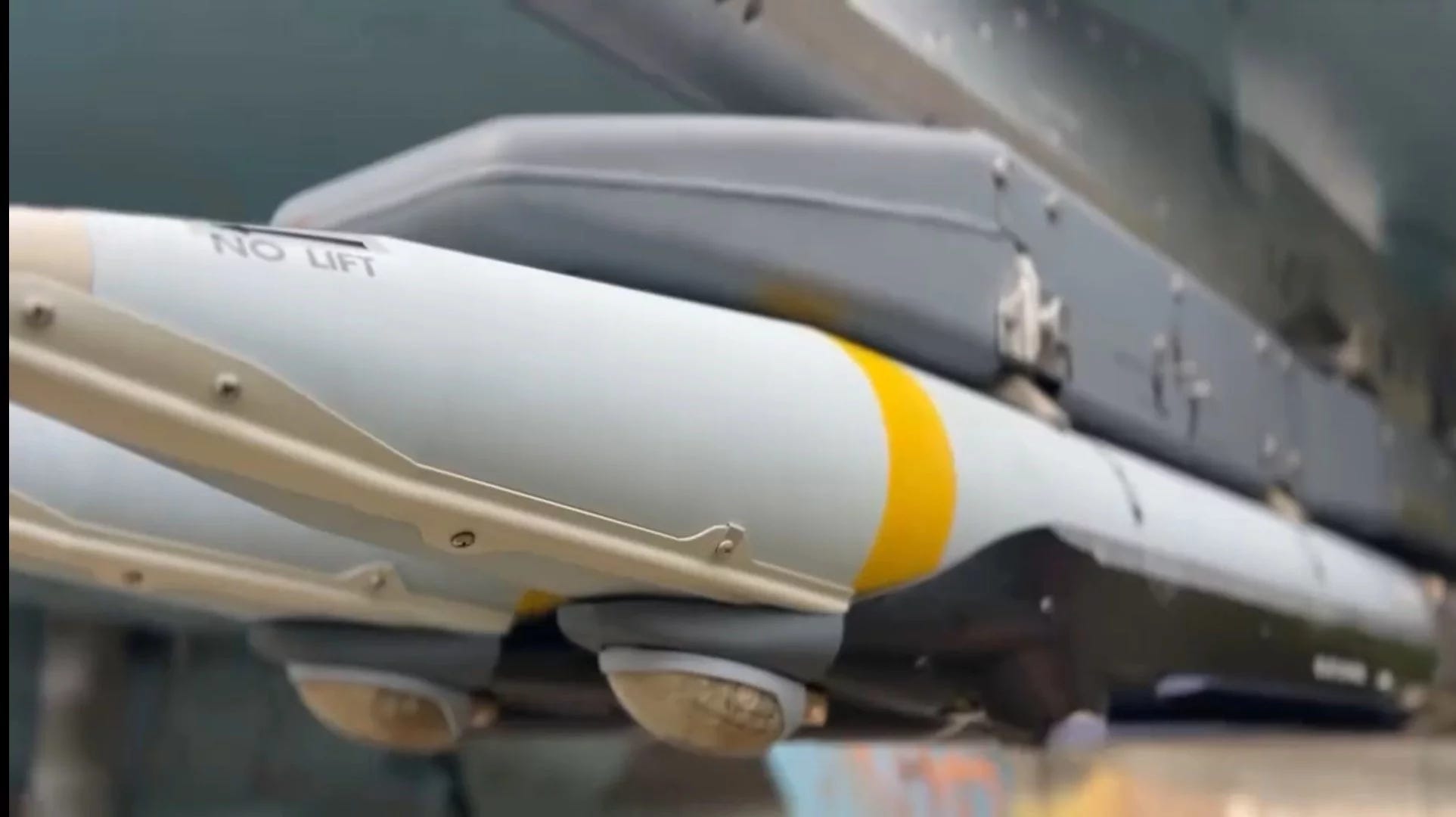
Ukrainian GBU-39 glide bombs / UKR Ministry of Defence
UKRAINE’S STRATEGIC LONG-RANGE DRONE WAR
Ukraine now has genuine cruise missiles and longer range and more powerful drones. They are devastating Russia’s oil industry; its chief revenue earner.
——————————————
TUAPSE BURNS FOR 8 DAYS (AND COUNTING)
——————————————
All last week, Ukraine continued to target oil refineries, pumping stations, and storage depots. There were too many attacks for me to list right now, but I want to highlight just one of those attacks. It brings together so much of what is in the rest of this report.
The Russian refinery in Tuapse burned for most of last week after repeated waves of drone attacks. Tuapse is about 50km north-west of the site of Sochi Winter Olympics and Putin’s summer palace. It is safe to conclude that a prolonged assault on this scale could only happen because Russia’s air defences are being obliterated.
——————————————
DAY ONE
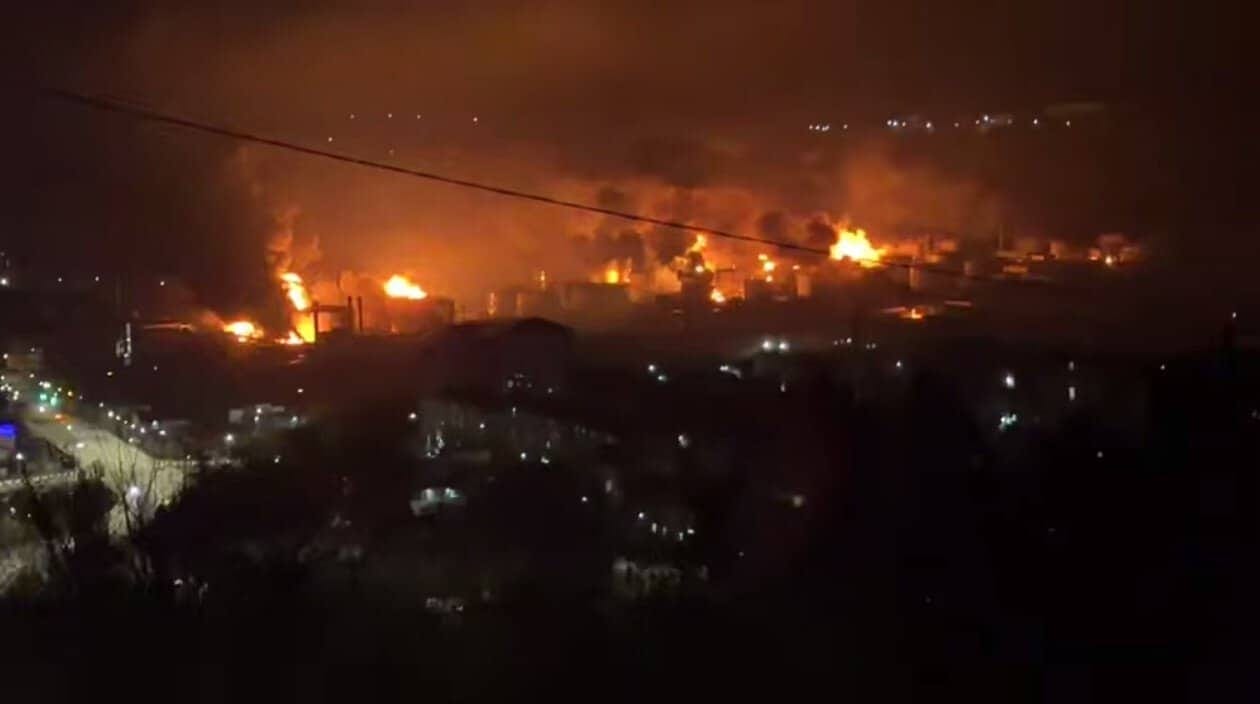
Tuapse oil refinery after the first attack / Source: Astra
Tuapse Oil Refinery Hit by Ukrainian Drone Strike, Large Fire Reported
link
“The attack occurred on the night of April 19–20, 2026. As a result of a large-scale strike, a significant part of the refinery’s tank farm caught fire. The facility is capable of processing up to 12 million tons of oil per year… the total storage capacity for crude oil and petroleum products exceeds 1.5 million cubic meters.”
——————————————
DAY THREE
Two days later the refinery was still in flames. After another wave of drone strikes, black rain began to fall.
Oil Rain Falls
link
“Residents reporting “The attack occurred on the night of April 19–20, 2026. As a result of a large-scale strike, a significant part of the refinery’s tank farm caught fire.” and oily residue as heavy smog spreads “

Droplets of crude oil are raining down around Tuapse / Open source
Then the fire-fighters appeared to give up.
Could This Be More Russian?
link
“Tuapse, the firefighters are unable to extinguish the fire, so they decided just to take photos in front of it”
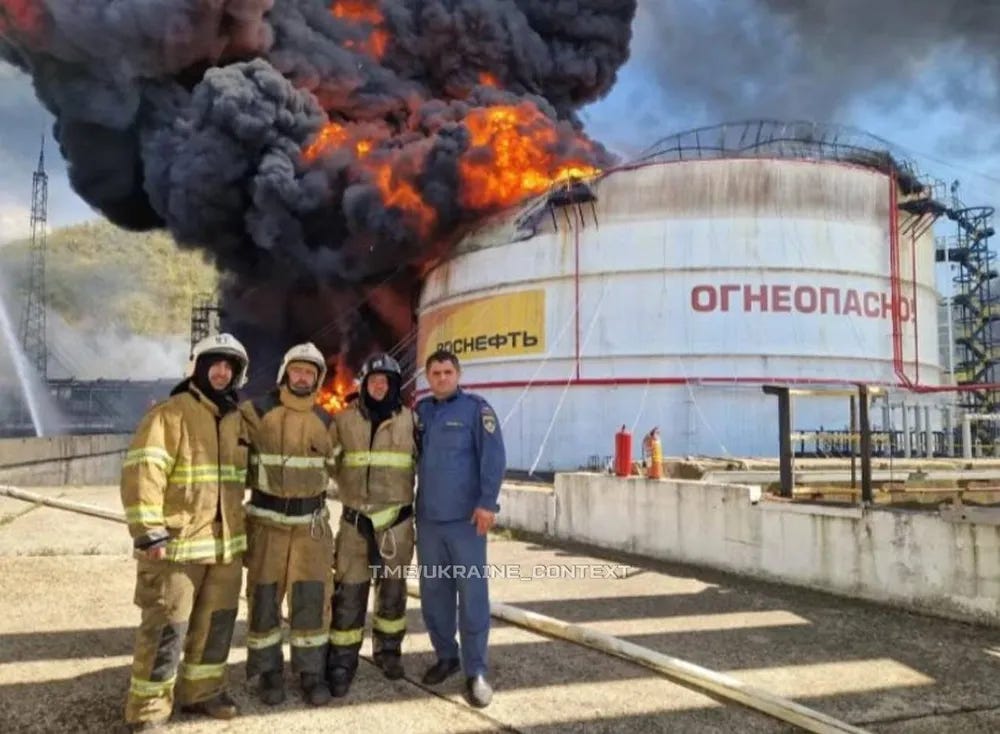
Whilst Tuapse burns, firemen pose / Open source
——————————————
DAY EIGHT
And the refinery has just caught fire once more (Tuesday 28th April) after yet another drone attack.
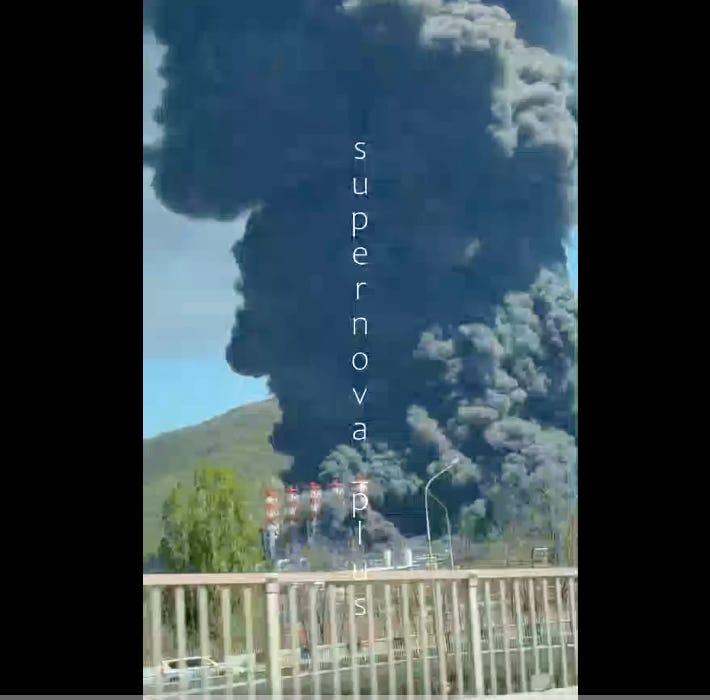
Another multiple drone attack sets Tuapse ablaze again / Video Screengrab Supernova
Tuapse Burns Again
link
“Several fuel tanks exploded in Tuapse, flooding a large part of the refinery with fuel and rapidly spreading the fire.”
——————————————
TUAPSE AND THE UNDER-REPORTED WAR
——————————————
Just as I was readying this bulletin for publication at midday on April 28th, I finally heard a report about the Tuapse fire. It was on the BBC news and was excellent in its detail and accuracy but, but, but…it was eight days after the initial attack. Eight days.
In the interim, there have been numerous opportunities no journalist should be able to resist reporting: the initial attack on a strategic oil refinery ablaze, black oil rain falling, those fire-fighters and more. All with readily available powerful imagery to be used and yet…
Sigh… you might almost think this war is under-reported and has been for almost four years.
I’ll be back next week. My apologies for ending on a negative note since so much of this bulletin is positive. Just remember: Orbán is gone, Ukraine’s EU membership is being fast-tracked, Ukraine is tearing Russia’s air defences apart, and, thanks to the EU and UK, frozen Russian assets generate hard cash for Ukraine to fight its war against him.
Every day, Ukraine grows stronger and Russia grows weaker.
Slava Ukraini!
Excellent !
Can’t wait till Russia seeks an opportunity to negotiate peace terms including the return of all Ukrainian land including Crimea.
Maybe Putin and trump could share a small condo in North Korea…